
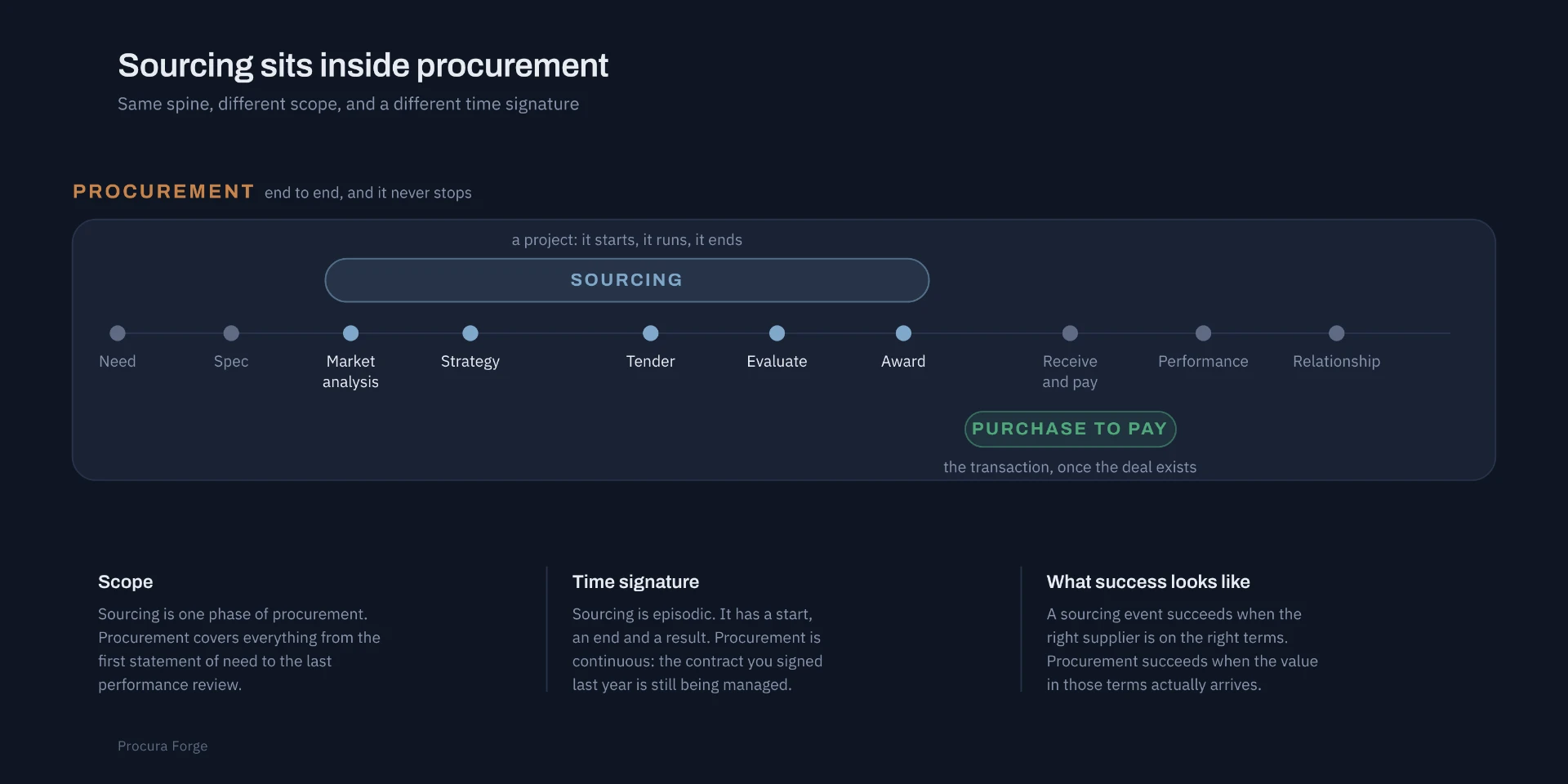
The textbook answer is that sourcing is a subset of procurement. True, and almost useless. The difference that matters in an operating business is not one of scope but of time horizon, and the handover between the two is where most organisations lose money without ever recording a loss.
Table of Contents
Two different jobs wearing the same job title
Both sit inside the wider discipline described in what is procurement, but they behave so differently in practice that treating them as one job is the root of the problem.
Sourcing works in months. It asks who should supply this, on what commercial shape, and what happens if they cannot. The output is a decision and a contract, and the skills involved are analytical and commercial: market structure, cost modelling, negotiation, risk assessment.
Procurement in its operational sense works in days. It asks whether the right quantity arrives at the right place on the right date at the agreed price. The output is delivered material and a settled invoice, and the skills are operational: expediting, systems discipline, exception handling, stakeholder management.
Both are demanding and neither is senior to the other, but they reward opposite instincts. Sourcing rewards patience, because the best commercial outcome often requires waiting for a market to move. Operations rewards urgency, because a line stopped today costs money today. Put the same person under both pressures and urgency wins every time, which is why organisations that never separate the two end up with no sourcing at all.
The handover is where value disappears
Most published comparisons stop at the definitions. The expensive part is what happens between them.
A sourcing team negotiates a three year agreement with a volume rebate at 10,000 units, a defined escalation formula tied to a published index, and a service credit for late delivery. The contract is signed and filed. Eighteen months later nobody has claimed the rebate because no one is tracking cumulative volume, the supplier has applied escalation using a different index and nobody has checked, and three late deliveries have gone unremarked because the service credit sits in a clause nobody operational has read.
None of that appears as a loss. The savings were reported at signature and the budget was reset accordingly. The value simply never arrived, and because the baseline already assumed it, nothing in the management accounts shows the gap.
This is the single most common failure in the sourcing to operations handover, and it is not solved by better contracts. It is solved by someone owning the commercial terms after signature, with the obligations extracted into something an operational buyer will actually see.
Which one needs your attention depends on where the money is
The honest answer to where to invest is that it depends on your spend profile, and the test is quick.
If a small number of suppliers account for most of your spend, the leverage is in sourcing. Better market analysis, better commercial structures and genuine competitive tension on a handful of large agreements will move more money than any amount of transactional efficiency.
If your spend is spread across hundreds of suppliers with no single one dominant, the leverage is operational. Consolidation, catalogue buying, approval discipline and controlling maverick spend will recover more than renegotiating any individual contract.
Most organisations have both patterns in different categories and apply one approach to everything, usually whichever one the current director came up through. Running a full strategic sourcing exercise on fragmented tail spend wastes months. Managing a single-source strategic component transactionally invites the failure that stops production, which is the argument for running a proper supplier risk analysis on those few items before the failure rather than after it.
Frequently asked questions
Is sourcing part of procurement?
Yes. Sourcing is the upstream strategic activity within the wider procurement discipline. In practice many organisations staff them as separate teams, which works well as long as someone owns the handover between them.
What comes first, sourcing or procurement?
Sourcing establishes the supplier and the commercial terms, and operational procurement then executes against them. The exception is an emergency buy, where operations moves first and sourcing regularises the arrangement afterwards, which is fine occasionally and corrosive as a habit.
What is strategic procurement?
Procurement run against long-term business objectives rather than individual transactions, judged on total cost of ownership and risk exposure rather than the lowest invoice price.
Should the same person do both?
In a small organisation they have to, and the way to make it survivable is to protect sourcing time in the calendar explicitly. Without that protection the urgent work consumes all of it, and the strategic work is permanently deferred.
A short test for your own organisation
Pick a contract signed more than a year ago that reported a saving. Find out who owns it today, whether anyone has checked the pricing against the agreed mechanism, and whether any of the commercial protections in it have ever been used.
If you can answer all three quickly, the handover is working. If you cannot, the gap between your sourcing and your operations is costing you a figure nobody has written down, and finding it is a better use of a week than another tender. The connected discipline that closes this gap over time is category management, which treats a category as an ongoing responsibility rather than a series of sourcing events.
WRITTEN BY
Mehmet KaraveliogluCo-founder & CEO · Procura Forge B.V.
Mehmet Karavelioglu is a Global Category Manager with over a decade of experience across green hydrogen infrastructure, EV charging and consumer electronics. His career spans three industries and four companies, with a consistent focus on building category strategies that hold up under commercial pressure, technical complexity, and shifting supply market conditions.
LinkedIn →