
Most definitions of procurement describe a process. The more useful definition describes a responsibility. Procurement is the function accountable for whether the organisation can keep making and selling what it sells, at a cost it can survive, with suppliers that will still exist in two years. Everything else, the purchase orders, the tenders, the three-way matching, is machinery built to deliver on that.
Table of Contents
- i.Procurement is not purchasing, and the gap between them is where money leaks
- ii.The procurement cycle, and which stages actually get run
- iii.Total cost of ownership, worked through rather than asserted
- iv.Where a procurement team actually spends its week
- v.Frequently asked questions
- vi.What good actually looks like
Procurement is not purchasing, and the gap between them is where money leaks
Purchasing is the transaction. Someone needs a part, a requisition is raised, an order goes out, goods arrive, an invoice is matched and paid. It is measurable, repeatable, and largely a question of speed and accuracy.
Procurement is everything that decides whether that transaction was a good idea in the first place. Should the part be bought at all, or designed out? Should it come from one supplier or two? Is the price the right price, or simply the price that was quoted? Those questions are answered months before the purchase order exists, and once answered they are expensive to revisit.
That timing is why the distinction matters commercially rather than semantically. By the time a buyer is negotiating a purchase order, the specification is written, the supplier is qualified and the lead time is fixed. Most of the available value was decided upstream and has already been spent or saved. The detail of how the two functions divide is covered in sourcing vs procurement, which is worth reading if you are deciding who in your organisation owns which part.
The procurement cycle, and which stages actually get run
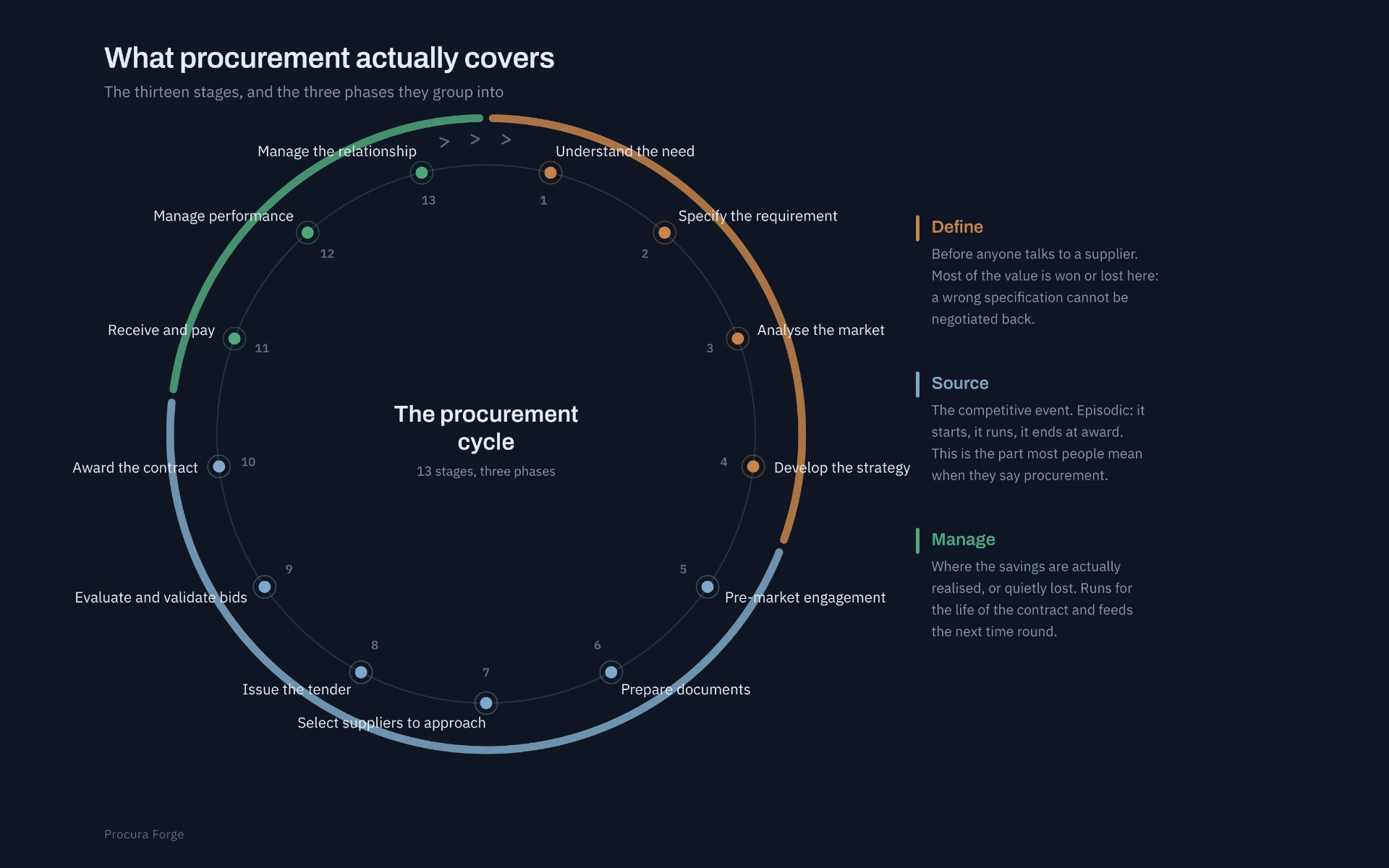
The CIPS procurement cycle describes thirteen stages, running from defining the need through market analysis, specification, supplier selection, tendering, award, delivery, contract management and eventual asset disposal. It is a good map. It is also an idealisation, and treating it as a checklist rather than a map is a common mistake.
In practice the stages get very different amounts of attention. Defining the need and writing the specification often take a single afternoon, usually because engineering has already decided and procurement is being asked to execute. Tendering and evaluation take weeks and feel like the real work, because they generate documents and meetings. Contract management after award frequently gets nothing at all, which is where the value quietly escapes.
The cycle also assumes each purchase is a fresh project, moving cleanly from stage one to stage thirteen. Real procurement loops. A design change sends you back to specification. A supplier failure sends you back to market analysis. A repeat buy skips eight stages entirely and should, because running a full tender on a routine rebuy costs more in internal time than it saves in price.
The judgement, then, is not whether to follow the cycle. It is knowing which stages genuinely need the time on this particular purchase, and being able to defend that choice when audit asks.
Total cost of ownership, worked through rather than asserted
Every procurement text says to buy on total cost of ownership rather than price. Fewer explain what that changes in practice, so here is the arithmetic that actually moves a decision.
Take a fabricated component quoted at 100 by a local supplier and 72 by an overseas one. The overseas quote looks like a 28 percent saving. Then add freight and duty, which on a bulky fabrication can run 8 to 12 percent. Add the inventory you have to hold to cover a twelve week lead time instead of three, which on a reasonable cost of capital is another few points. Add the quality cost of a longer feedback loop, where a defect found on the line is nine weeks from being fixed at source rather than one. Add the engineering hours to qualify the supplier in the first place.
The gap usually survives all of that, but it narrows to something closer to 10 percent than 28, and that is a different conversation. It is no longer obviously worth the risk concentration, and it is certainly not worth it for a component where supply interruption stops the line.
The useful discipline is not calculating total cost of ownership to three decimal places. It is forcing the comparison to include the costs that land in somebody else's budget, because those are the ones a price-only decision quietly transfers rather than removes.
Where a procurement team actually spends its week
Ask a procurement director what the team does and you will hear about strategy, savings and supplier relationships. Look at the calendar and you will usually find something else: expediting late deliveries, chasing internal approvals, resolving invoice mismatches, and answering the question of where something is.
This is not a failure of discipline so much as a failure of structure. Firefighting is generated upstream. A specification written too tightly produces a single qualified supplier, and a single qualified supplier produces expediting calls. A contract with no agreed performance review produces quality drift, and quality drift produces inspections. The daily crisis is almost always the delayed invoice for a decision made six months earlier.
Teams that escape the loop tend to do one specific thing. They protect a fixed, defended block of time for category management, and they treat it as unavailable rather than as the first thing to sacrifice when something goes wrong. Without that, the urgent will take all of it, permanently.
Frequently asked questions
What is the main purpose of procurement in a business?
To secure continuity of supply, optimise total cost of ownership, and manage the risk that a supplier failure becomes a business failure. Savings matter, but they are the third objective rather than the first.
What is the difference between purchasing and procurement?
Purchasing is the transactional act of buying. Procurement is the end-to-end discipline that decides what gets bought, from whom, on what terms, and what happens after the contract is signed.
How is AI changing procurement?
Mostly by removing the preparatory work rather than the decisions. Spend classification, market research, first-draft category analysis and contract review all compress from days to minutes. What it does not supply is judgement about which trade-off your organisation should accept, which still has to come from someone who has made that call before.
Does procurement need to sit in finance?
It reports into finance in many organisations and into operations in many others, and both work. What matters more than the reporting line is whether procurement is involved before the specification is frozen. A function brought in afterwards is a purchasing function regardless of what the org chart calls it.
What good actually looks like
A procurement function working well is not the one with the most savings reported. Reported savings are easy to generate and hard to verify, and the number usually says more about the baseline chosen than the value created.
The more honest indicators are quieter. How often does a supplier issue reach the customer before it reaches procurement? How much of last year’s spend went through a contract someone had actually read? When a supplier failed, how long before anyone noticed, and was there a second source already qualified, which is the question dual sourcing exists to answer?
Those questions are harder to put in a board pack than a savings number, which is precisely why they are worth asking.
WRITTEN BY
Ilkan YudulmazCo-founder & CTO · Procura Forge B.V.
Ilkan Yudulmaz is a Global Category Manager with over a decade of experience across green hydrogen infrastructure, EV charging, and consumer electronics. His career has been defined by taking on progressively larger commercial mandates, from component-level sourcing to managing portfolios exceeding $250 million across technically complex and fast-moving supply markets.
LinkedIn →