
Knowing you spent 10 million on logistics is not a strategy. It is a number. Category management is the discipline that turns that number into a set of decisions, and the difference between the two is whether anyone can tell you what should change as a result.
Table of Contents
What a category actually is, and why the boundary matters
A category is a group of goods or services that share a supply market. The definition sounds academic until you draw the boundary wrongly, at which point it quietly invalidates everything downstream.
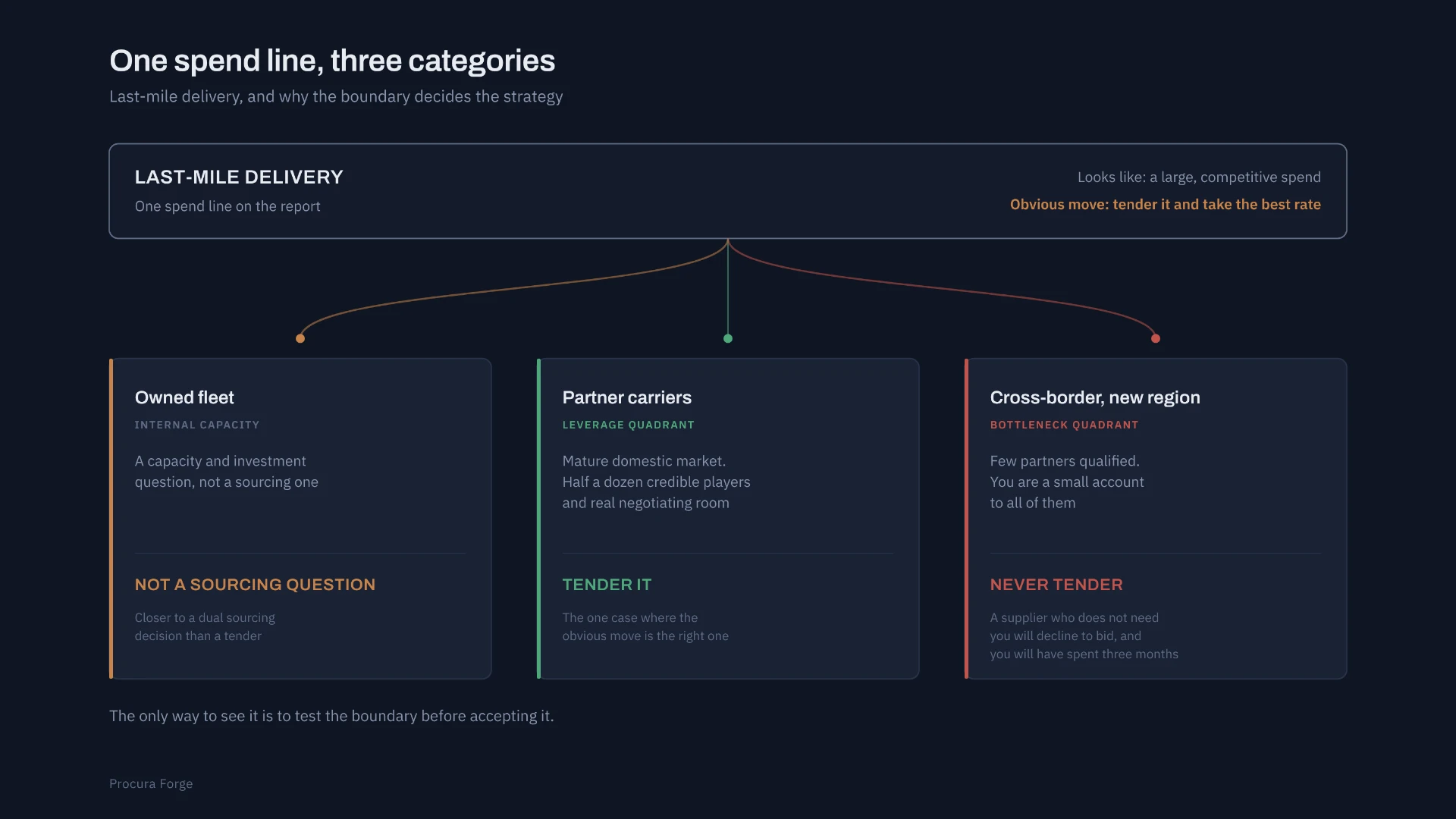
Consider last mile delivery for an online retailer. Treated as one category it looks like a large, competitive spend where the obvious move is to tender it and take the best rate. Look closer and it is at least three different things. Deliveries made by an owned fleet are a capacity and investment question, not a sourcing one. Partner carriers in a mature domestic market are a leverage category with half a dozen credible players and real negotiating room. Cross-border delivery into a new region is a bottleneck, where few partners are qualified, you are a small account to all of them, and running a competitive event will not win you priority.
Those three sit in different quadrants of the Kraljic matrix and need opposite strategies. Tender the middle one. Never tender the third, because a supplier who does not need you will simply decline to bid, and you will have spent three months to learn that. The first, where you carry the capacity yourself, is closer to a dual sourcing question than a sourcing one. One spend line, three categories, and the only way to see it is to test the boundary before accepting it.
The six steps, and where they usually stall
The standard category management process runs through six stages: profile the spend, analyse the supply market, develop the strategy, execute the sourcing plan, implement supplier management, and review continuously. The sequence is sound. What the diagram does not show is that organisations reliably stall at the same two points.
The first stall is between analysis and strategy. Teams produce a thorough spend profile and a competent market analysis, and then stop, because turning analysis into a decision requires committing to a position that could be wrong. A document that describes the market is safe. A document that says we should consolidate from six suppliers to two, accept a higher unit price on the remainder, and carry the concentration risk deliberately is a decision someone can be blamed for. The second is more useful and far rarer.
The second stall is between execution and supplier management. The sourcing event completes, the contract is awarded, the savings are booked, and the team moves to the next category. Stage five never happens, usually because no measurement rhythm was set up, which is what a supplier scorecard provides. This is why so much category work has to be redone from scratch three years later: nothing was managed in between, so there is nothing to build on.
Category management is governance, not a project
The distinction from strategic sourcing is worth being precise about, because the two are routinely conflated. Strategic sourcing is an event with a start and an end. Category management is a standing responsibility with no end date.
That difference shows up in how the work is resourced. A sourcing event justifies a project team and a deadline. Ongoing category governance justifies neither, which is why it loses every time it competes with something urgent. If a category manager owns twelve categories and three live tenders, the twelve categories receive whatever is left, which is nothing.
The organisations that make it work do something unglamorous. They give each category a named owner, a documented strategy of a page or two rather than forty, and a fixed review date in the calendar. The review happens whether or not anything has changed, and most of the time it takes twenty minutes and confirms the strategy still holds. The value is in the few times it does not.
Connecting the category to something the business cares about
Category strategies fail to get support when they are written in procurement language for a procurement audience. A strategy that promises a 4 percent reduction in unit cost is interesting to procurement and invisible to everyone else.
The same strategy expressed as what it protects or enables tends to travel much further. Qualifying a second supplier is not a procurement initiative, it is removing the single point of failure that would stop production for nine weeks. Consolidating a fragmented category is not tidying, it is releasing working capital and cutting the administrative load on a team that is already late on everything.
This is not presentation varnish. It changes which strategies get approved, because the people approving them are not measured on procurement metrics.
Frequently asked questions
What is category management in procurement?
Grouping related spend into categories that share a supply market, and managing each as an ongoing responsibility with its own strategy, owner and review cycle.
How does it differ from strategic sourcing?
Sourcing is a project with a defined end. Category management is continuous governance that includes sourcing events as one of its activities. The relationship between the two is covered in more depth in sourcing vs procurement.
Who should own a category?
A named individual with commercial authority and enough technical understanding to challenge a specification. Shared ownership across a committee produces analysis and no decisions.
How many categories can one person manage?
Fewer than most organisations assume. Genuine ownership of a complex category is measured in days per month, not hours per year, and a manager holding more than a handful is in practice holding none of them.
Where to start if you have nothing
Do not begin with a spend cube covering every category. That takes months and produces a document rather than a change.
Take one category that matters, where you have a problem you can name. Test whether it is really one category or several. Work out who the suppliers actually are and what their position is relative to yours. Write a page that says what you are going to do differently and why. Put a review date on it.
That page will be more useful than any spend analysis, because it commits to something. Once one category has a real strategy that someone owns, the second is considerably easier, and the argument for resourcing the rest makes itself.
WRITTEN BY
Mehmet KaraveliogluCo-founder & CEO · Procura Forge B.V.
Mehmet Karavelioglu is a Global Category Manager with over a decade of experience across green hydrogen infrastructure, EV charging and consumer electronics. His career spans three industries and four companies, with a consistent focus on building category strategies that hold up under commercial pressure, technical complexity, and shifting supply market conditions.
LinkedIn →