
Most supplier risk assessment happens once a year, produces a spreadsheet with a traffic light column, and predicts nothing. The problem is not the effort. It is that an annual snapshot of a supply base that changes weekly tells you what was true in March, and suppliers do not fail in a way that waits for your review cycle.
Table of Contents
- i.Four kinds of risk, and only one of them is usually measured
- ii.Reading a set of accounts without being an accountant
- iii.The signals that arrive before the accounts do
- iv.A five step method you can actually run
- v.What to do when the best supplier is the weakest one
- vi.Frequently asked questions
- .The test that matters
Four kinds of risk, and only one of them is usually measured
Supplier risk is not one thing, and the four varieties behave differently enough that a single score hides more than it reveals.
Financial risk is whether the supplier will still be solvent. It is the most measurable of the four, because filed accounts exist and ratios can be calculated, and it is still the one most often skipped.
Operational risk is whether they can actually deliver: capacity, single points of failure in their own plant, dependence on one piece of equipment or one engineer, and their own supply base two tiers down.
Geopolitical risk is whether the route between you and them stays open. Tariffs, export controls, port closures, currency moves and sanctions all sit here, and they move faster than any review cycle.
Compliance and cyber risk is whether they are a liability to you independent of delivery: data breaches, labour practices in their supply chain, environmental exposure. This one is rarely about continuity and almost entirely about your reputation and your legal position.
Reading a set of accounts without being an accountant
Financial assessment gets skipped because it looks like somebody else’s expertise. In practice four numbers will tell a buyer most of what they need, and all four come off a published balance sheet and profit and loss.
Start with the revenue trend over three years. A supplier shrinking year on year is under pressure whatever else the accounts say, and pressure shows up in your deliveries before it shows up in an insolvency notice. Next, gross and net margin, and more importantly the direction of travel. A supplier whose margin is compressing will eventually come back to you for a price increase or quietly start cutting corners on quality.
Then the current ratio, which is current assets over current liabilities. Below one means they cannot cover their short-term obligations from short-term assets, which is the position from which suppliers start asking for payment up front. Finally gearing, which is debt as a proportion of capital employed. Above roughly 50 percent is considered highly geared, and a highly geared supplier in a rising interest environment is carrying a cost you will eventually be asked to share.
None of these are predictions. They are a way of deciding where to look harder, which is all a screening tool should ever claim to do.
The signals that arrive before the accounts do
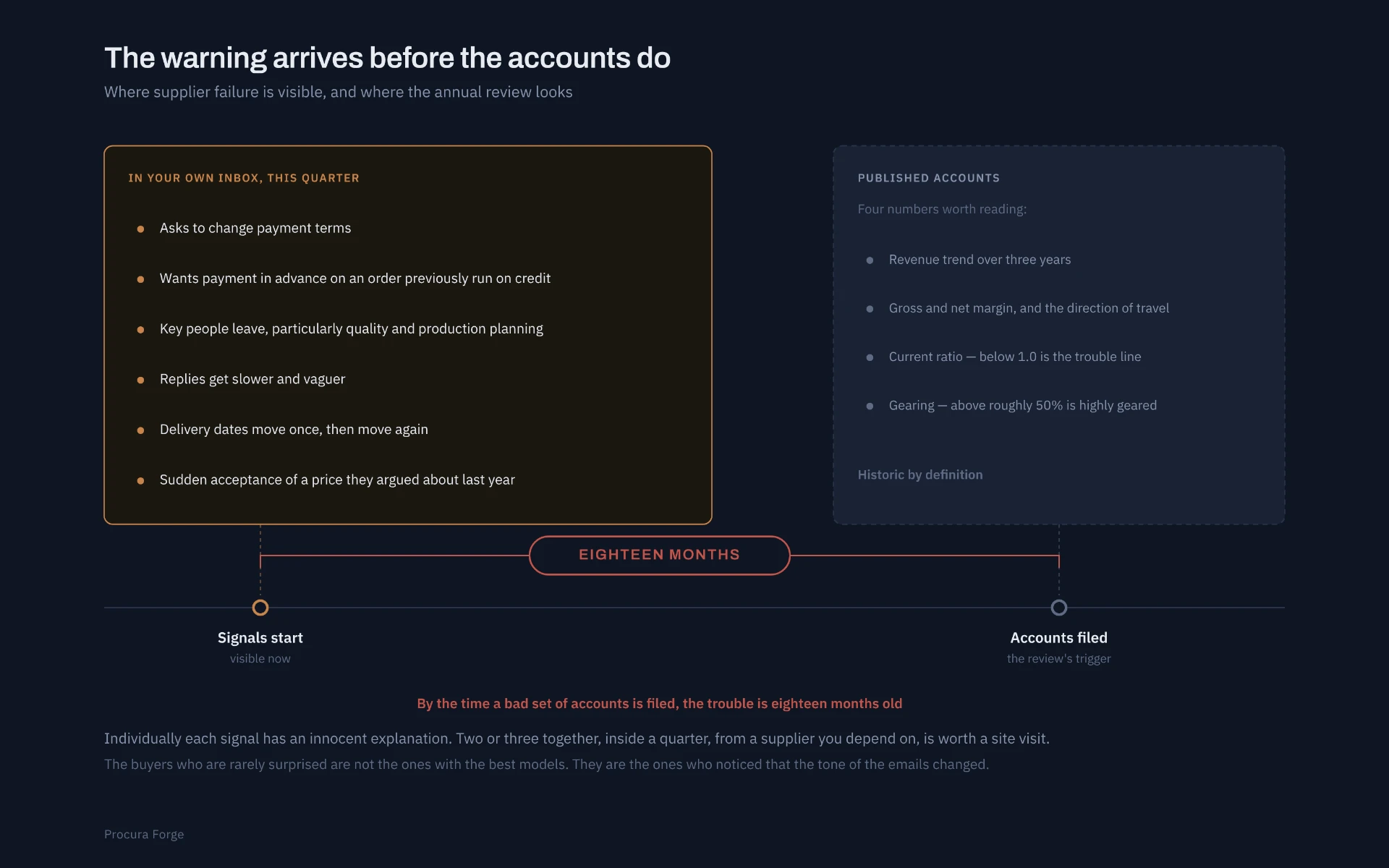
Published accounts are historic by definition. By the time a bad set is filed, the trouble is eighteen months old. The useful early warnings are operational and they show up in your own inbox first.
Watch for a supplier who starts asking to change payment terms, or requests payment in advance on an order they previously ran on credit. Watch for key people leaving, particularly in quality and production planning. Watch for responses getting slower and vaguer, for delivery dates that move once and then move again, and for a sudden willingness to accept a price they argued about last year.
Individually each has an innocent explanation. Two or three together, inside a quarter, from a supplier you depend on, is worth a site visit. The buyers who are rarely surprised by a supplier failure are not the ones with the best models. They are the ones who noticed that the tone of the emails changed.
A five step method you can actually run
The method below is deliberately modest. It can be completed for a critical category in a week, which matters more than completeness, because a thorough method that never gets run protects nothing.
- Map tier one and, for critical items, tier two. You cannot assess a dependency you have not identified, and single points of failure usually hide one level below the supplier you talk to.
- Quantify exposure rather than scoring it. For each critical supplier, estimate what their failure costs per week of interruption. A number creates urgency that a red traffic light does not.
- Identify where you are single sourced and whether that was a decision or an accident. Most single sourcing is accidental, inherited from a specification written years ago by someone who has left, and dual sourcing is the usual remedy where the exposure justifies it.
- Set up monitoring proportionate to the exposure. Credit alerts on the suppliers whose failure would stop production, and nothing at all on the ones you could replace in a fortnight.
- Write the playbook before you need it. For each critical supplier, one page on what happens if they stop delivering on Monday: who is called, what stock exists, which alternative is qualified, and how long requalification takes.
What to do when the best supplier is the weakest one
The uncomfortable case is a supplier who is technically the right answer and financially fragile. Refusing to award on that basis alone is often wrong, because the specialist capability may genuinely not exist elsewhere.
The practical answer is to award and build protection around it. Milestone payments rather than large advances, so your exposure at any point is bounded. Retention of title on materials you have paid for. A parent company guarantee if they are part of a larger group. Tooling that you own and can physically remove. A second supplier qualified in parallel even if they never receive volume. Closer monitoring than you would otherwise apply, agreed openly rather than imposed quietly.
Each of those has a price, and the supplier will push back on some of them. That negotiation is the real risk work, and it is more valuable than any scoring exercise.
Frequently asked questions
What is supplier risk analysis?
The systematic assessment of financial, operational, geopolitical and compliance vulnerabilities across your supply base, in order to act before a disruption rather than after one.
How do you calculate supplier risk exposure?
Multiply the likelihood of an interruption by what that interruption costs you per week. The second number is the one most organisations have never worked out, and it is the one that persuades a budget holder.
How often should supplier risk be reviewed?
Continuously for the handful of suppliers whose failure would stop you, and annually for everyone else. A single review cadence applied to the whole supply base is either too slow where it matters or wasted effort where it does not.
What if the supplier files abbreviated accounts?
Small private companies and overseas suppliers often publish very little. Fall back on credit agency data, payment behaviour reported by other customers, a site visit, and whether they are willing to discuss their order book. Reluctance to talk about capacity is itself a signal. A structured performance record also helps, which is what a supplier scorecard gives you over time.
The test that matters
A supplier risk process is working if it has changed a decision. Not produced a report, not populated a dashboard, changed a decision.
If you cannot point to an award that went differently, a second source that was qualified early, or a payment term that was tightened because of what the analysis showed, then the process is documentation rather than risk management, however thorough the spreadsheet looks.
WRITTEN BY
Ilkan YudulmazCo-founder & CTO · Procura Forge B.V.
Ilkan Yudulmaz is a Global Category Manager with over a decade of experience across green hydrogen infrastructure, EV charging, and consumer electronics. His career has been defined by taking on progressively larger commercial mandates, from component-level sourcing to managing portfolios exceeding $250 million across technically complex and fast-moving supply markets.
LinkedIn →